
(English version below)

Un buco nero è una regione dello spaziotempo dove la forza di gravità è così forte che neppure la luce è in grado di scappare. Dato un corpo celeste, maggiore è la sua massa e minore è il raggio, più alta sarà la velocità necessaria a sfuggire – per questo bisogna imprimere un’accelerazione sufficiente alle missioni spaziali che lasciano la Terra. In un buco nero, il rapporto M/r è così grande che ci vorrebbe una velocità maggiore a quella della luce per sfuggire. Così esso inghiotte tutto ciò che oltrepassa un confine detto raggio di Schwarzschild rS o orizzonte degli eventi. Perché la luce non può sfuggire, i buchi neri sono invisibili. Tuttavia, la loro presenza è tradita dall’effetto gravitazionale su ciò che è vicino. In particolare, il gas catturato spiraleggia attorno al buco nero rilasciando radiazione elettromagnetica e formando un disco di accrescimento assai luminoso.
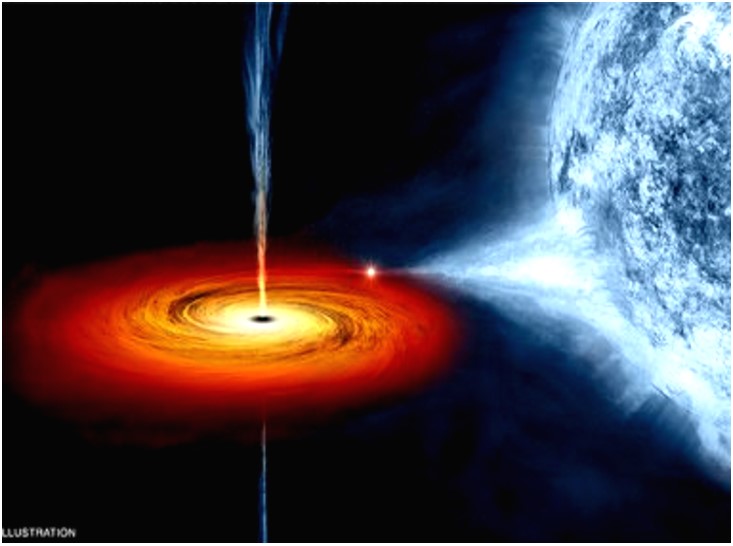
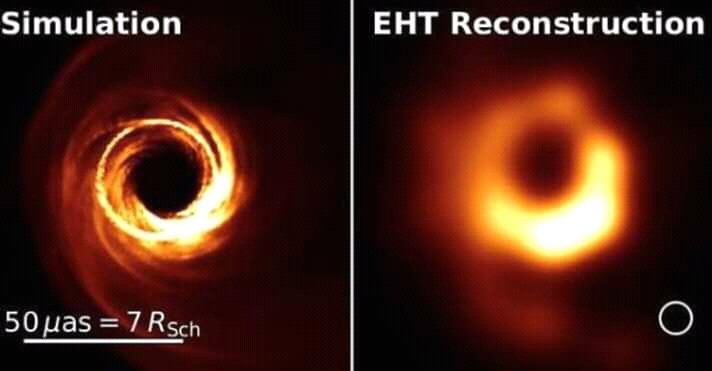
Esistono diversi tipi di buchi neri. Al crescere della massa, si distinguono buchi neri stellari (3-100 masse solari), buchi neri di massa intermedia (103-104 masse solari) e buchi neri supermassivi (106-109 masse solari), data la massa del Sole che vale 1030 kg = 1 000 000 000 000 000 000 000 000 000 000. I primi sono ciò che rimane dopo la morte di una stella supergigante, purché dopo l’espulsione di vari strati durante la fase di supernova rimanga una massa di almeno 3 masse solari concentrata in uno spazio di qualche decina di km. I secondi e i terzi si trovano rispettivamente al centro degli ammassi globulari e delle galassie. Un buco nero supermassivo di 108 masse solari ha un orizzonte degli eventi pari al diametro dell’orbita terrestre = 16 minuti luce = 300 milioni km. Il buco nero al centro della Via Lattea si chiama Sagittarius A e ha una massa pari a 4 milioni di masse solari. Il buco nero di cui è stata ottenuta la prima immagine, quello della galassia M87 (centro dell’ammasso della Vergine), ha una massa di 6 miliardi di masse solari; la foto è stata ottenuta con una rete di telescopi sparsi su tutto il globo. I buchi neri supermassivi dell’universo locale sono comunque molto meno attivi di quelli dell’universo lontano del passato, i quali danno origine ai luminosissimi quasar per via dei loro enormi dischi di accrescimento.
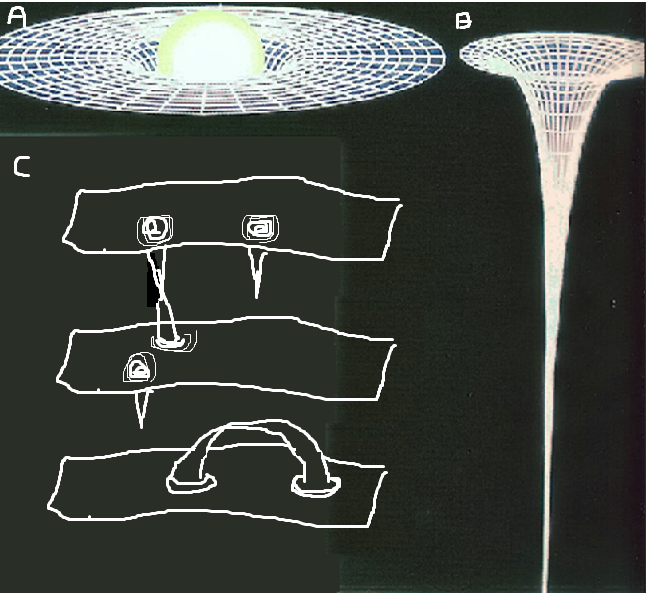
In prossimità di un buco nero l’alta forza gravitazionale deforma lo spaziotempo. Il tempo rallenta man mano che ci si avvicina all’orizzonte degli eventi e si ferma completamente sull’orizzonte stesso. A questo punto, spazio e tempo si scambiano e il buco nero non è più un punto nello spazio, ma un momento nel futuro: inevitabile. Secondo la relatività generale, ogni oggetto con massa scava un ‘pozzo’ nello spaziotempo: un buco nero scava un pozzo profondissimo che collassa in un punto di densità infinita, una singolarità a r=0. Tale pozzo si estende in un iperspazio all’esterno del nostro universo, il bulk. Secondo la teoria delle superstringhe, il nostro infatti è uno dei tanti universi, o brane, che si trovano in un iperspazio di dimensioni superiori. Poiché la nostra brana ha quattro dimensioni (le tre spaziali più quella temporale), il bulk ne ha cinque, come nel film Interstellar di Christopher Nolan (anche se matematicamente ci sarebbero sei dimensioni in più).
Esistono veramente più universi? Risolvendo le equazioni di relatività generale di Einstein e operando varie trasformazioni di coordinate rispetto a quelle originarie t, tempo, e r, coordinata radiale, si arriva a due nuove coordinate u e v che permettono di visualizzare la seguente geometria. Le linee diagonali corrispondono all’orizzonte degli eventi rS e dividono lo spaziotempo in quattro regioni: I è il nostro universo, II è il buco nero in cui tutto entra e nulla esce, III è un altro universo con la stessa geometria del nostro, IV è un buco bianco da cui tutto esce e nulla entra. La stessa relatività che prevede i buchi neri, prevede anche il loro opposto, i buchi bianchi, anche se non ne esiste alcuna osservazione reale. I due universi I e III sono connessi all’origine del diagramma da un wormhole, che però è troppo instabile per permettere a qualcuno di passare. In Interstellar un wormhole, passando attraverso il bulk, connette il nostro sistema solare con una galassia lontanissima nello stesso universo, ed è tenuto aperto dai misteriosi ‘esseri del bulk’ per permettere ai protagonisti di passare.

Quando la materia, ad esempio un coraggioso astronauta, viene catturata da un buco nero, viene stirata fino a diventare come un lungo spaghetto e dilaniata. Questa fine avviene rapidamente per un buco nero di poche masse solari. Ma dato che le forze gravitazionali mareali sono inversamente proporzionali al quadrato della massa del buco nero, se esso avesse una massa pari a 100 milioni di volte quella del Sole, l’astronauta potrebbe attraversare incolume l’orizzonte degli eventi e vivere alcuni minuti dentro. Se la massa fosse di 10 miliardi di masse solari vi potrebbe vivere addirittura un giorno intero. Poi, naturalmente, finirebbe sempre nello stesso modo: stirato e dilaniato. Chi osservasse la scena dall’esterno, a causa del rallentamento del tempo, non vedrebbe mai l’astronauta superare l’orizzonte degli eventi; sembrerebbe soltanto che egli rallenti piano piano e diventi sempre più sfuocato fino a scomparire, perché la luce da lui emessa impiega sempre più tempo ad uscire dal buco nero finché non esce più. Per ora insomma si sopravvive ad un buco nero solo nei film di fantascienza.

Fonti:
- Hobson, Efstathiou, Lasenby, 2006, General relativity: an introduction for physicists, Cambridge University Press, chapters 11.8-11.9-11.10
- Kip Thorne, 2018, La scienza di Interstellar: viaggiare nello spaziotempo, Bompiani
BLACK HOLES
A black hole is a region of spacetime where gravity is so strong that not even light is able to escape. Given a celestial body, the greater its mass and the smaller the radius, the higher is the speed necessary to escape – this is why space missions that leave the Earth must be given enough acceleration. In a black hole, the M/r ratio is so large that the speed necessary to escape would be higher than the speed of light. Thus, it swallows everything that crosses a boundary called the Schwarzschild radius rS or event horizon. Because light cannot escape, black holes are invisible. However, their presence is hinted by the gravitational effect on what is nearby. In particular, the captured gas spirals around the black hole releasing electromagnetic radiation and forming a very bright accretion disk.

There are different types of black holes. As the mass increases, stellar blackholes (3-100 solar masses), intermediate-mass black holes (103-104 solar masses) and supermassiveblack holes (106-109 solar masses) are distinguished, given the mass of the Sun 1030 kg = 1 000 000 000 000 000 000 000 000 000 000. The formers are what remains after the death of a supergiant star, provided that after the ejection of layers during the supernova phase, a mass of at least 3 solar masses concentrated in a space of a few tens of km is left. The seconds and thirds are respectively located at the center of globular clusters and galaxies. A supermassive black hole of 108 solar masses has an event horizon equal to the diameter of Earth’s orbit = 16 light minutes = 300 million km. The black hole at the center of the Milky Way is called Sagittarius A and has a mass equal to 4 million solar masses. The black hole of which the first image was obtained, that of the galaxy M87 (center of the Virgo cluster), has a mass of 6 billion solar masses; the image was obtained with a network of telescopes spread all over the globe. The supermassive black holes of the local universe are however much less active than those of the distant universe of the past, which give rise to very bright quasars due to their huge accretion disks.

Near a black hole, the high gravitational force deforms spacetime. Time slows down as you get closer to the event horizon and stops completely on the horizon itself. At this point, space and time swap and the black hole is no longer a point in space, but a moment in the future: inevitable. According to general relativity, every object with mass digs a ‘well’ in spacetime: a black hole digs a very deep well that collapses into a point of infinite density, a singularity at r = 0. This well extends into a hyperspace outside our universe, the bulk. According to the superstring theory, ours is in fact one of the many universes, or branes, that exist in a hyperspace of higher dimensions. Since our brane has four dimensions (the three spatial ones plus time), the bulk has five, as in Christopher Nolan’s Interstellar movie (although mathematically there would be six more dimensions).

Are there really more universes? By solving Einstein’s equations of general relativity and performing various coordinate transformations with respect to the original t, time, and r, radial coordinate, one arrives at two new coordinates u and v which allow to see the following geometry. The diagonal lines correspond to the event horizon rS and divide spacetime into four regions: I is our universe, II is the black hole where everything enters and nothing goes out, III is another universe with the same geometry as ours, IV is a white hole from which everything comes out and nothing enters. The same relativity that predicts black holes also predicts their opposite, white holes, even if no real observation exists. The two universes I and III are connected at the origin of the diagram by a wormhole, which however is too unstable to allow anyone to pass. In Interstellar a wormhole, extending through the bulk, connects our solar system with a very distant galaxy in the same universe, and is kept open by the mysterious ‘beings of the bulk’ to allow the protagonists to pass through.

When matter, for example a brave astronaut, gets caught by a black hole, it is stretched until it becomes like a long piece of spaghetti and torn apart. This fate would happen quickly for a black hole of a few solar masses. But since the tidal gravitational forces are inversely proportional to the square of the black hole mass, if it had a mass equal to 100 million solar masses, the astronaut could cross the event horizon untouched and live a few minutes inside. If the mass were 10 billion solar masses, he could even live there for a whole day. Then, of course, he would always end the same way: stretched and torn apart. Anyone observing the scene from the outside, due to the slowing of time, would never see the astronaut exceed the event horizon; it would only seem that he slows down little by little and becomes more and more out of focus until he disappears, because the light he emits takes more and more time to come out of the black hole until it no longer comes out. So far one can survive a black hole only in a science-fiction film.

References:
- Hobson, Efstathiou, Lasenby, 2006, General relativity: an introduction for physicists, Cambridge University Press, chapters 11.8-11.9-11.10
- Kip Thorne, 2018, La scienza di Interstellar: viaggiare nello spaziotempo, Bompiani

 ONE STEP BEYOND THE LIGHT CONE - UN PASSO OLTRE IL CONO LUCE