
(English version below)
CONTINUA DA “IMPERO O SOGNO DI DIO?” – CONTINUATION OF “EMPIRE OR GOD’S DREAM?”
“Per la mentalità androcratica l’idea che Gesù fosse coinvolto in una controrivoluzione gilanica è inconcepibile. Parafrasando la parabola, sembrerebbe più facile per un cammello passare per la cruna di un ago che per una nozione del genere entrare nella mente degli integralisti le cui auto oggi portano sui paraurti adesivi che esortano gli altri a seguire Gesù” (Riane Eisler, Il Calice & la Spada)
| Eventi principali | Date approx. |
| Nascita di Gesù | 7-5 B.C.E. |
| Morte di Erode il Grande: Giudea + Samaria ad Archelao, Galilea a Erode Antipa | 4 B.C.E. |
| Archelao allontanato, Giudea + Samaria provincia romana governata da procuratore | 6 C.E. |
| Morte di Gesù (Pilato procuratore Giudea, Tiberio imperatore) | 30 C.E. |
| Prima comunità a Gerusalemme, dispersione dopo martirio Stefano | 30-40 C.E. |
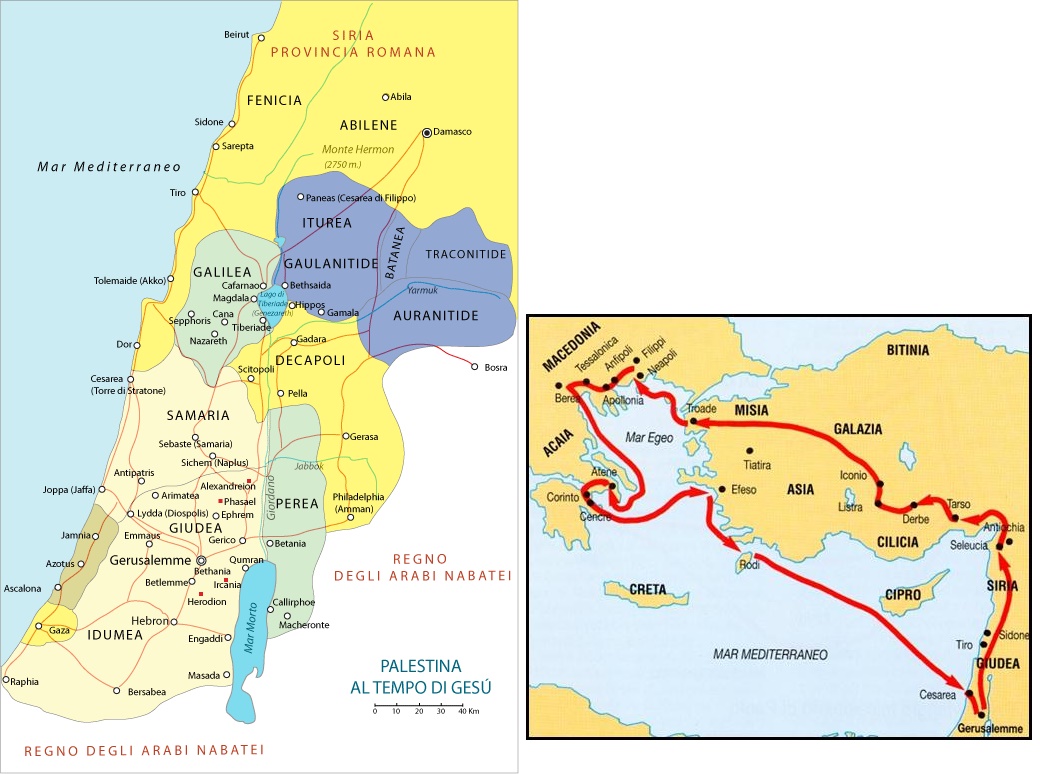
| Viaggi e Lettere autentiche di Paolo | 50-58 C.E. |
| Rivolta Zelota, Romani distruggono Tempio Gerusalemme; Vangelo di Marco | 66-70 C.E. |
| Vangeli di Matteo e Luca e Atti degli Apostoli | 80-90 C.E. |
| Vangelo di Giovanni e Apocalisse, Vangeli Gnostici | 100-110 C.E. |
| Repressione comunità Gnostiche | 200 C.E |
L’Impero Romano, ai tempi di Gesù, era tale che il 5% della popolazione possedeva tanto quanto il 95%. La Galilea era oppressa da ben tre tasse: all’imperatore, al governatore (Erode Antipa) e al Tempio di Gerusalemme. Per questo Gesù inizia la sua missione proprio qui, dalle vittime del sistema- poveri, malati, donne- per ricordare i valori di partnership: rispetto, compassione e amore.
Egli parla alle donne liberamente (Gv 4,7-27), propone loro di seguirlo al pari degli uomini superando il ristretto ruolo domestico (Lc 10,38-42), sfida la legge che vuole la lapidazione per l’adulterio (Gv 8,1-11). Lascia tutto, non lavora e invita gli altri a fare altrettanto come protesta non violenta, perché chi non lavora non deve pagare tasse all’impero. Incoraggia un’economia di condivisione (es. la moltiplicazione dei pani e dei pesci), basata sui detti “cerca di non arricchirti” e “se hai, è per condividere” (don Enrico Chiavacci). Insegna a riaffermare la propria dignità in modo non violento: es. Mt 5,38, porgi l’altra guancia perché hai diritto di essere picchiato come persona libera, con il palmo della mano, e non come schiavo, con il dorso.
Infine, Gesù porta il proprio messaggio al cuore del sistema, il Tempio di Gerusalemme – simbolo dell’uso strumentale che l’Impero fa della religione – dove però viene eliminato. Dopo la sua morte, inizialmente le comunità cristiane seguono il suo Sogno, come raccontano gli Atti degli Apostoli (es. la gestione comunitaria in At 2,42-47) e le Lettere autentiche di Paolo (7 delle 14 che gli vengono attribuite: 1° Tessalonicesi, 1° e 2° Corinzi, Galati, Filippesi, Filemone, Romani). Negli Atti risalta il ruolo di alcune discepole, soprattutto Lidia in At 16,14-15 e Priscilla in At 18; Paolo in Rm 16,1 ricorda la diacona Febe e in Gal 3,28 afferma “non c’è più giudeo né greco, non c’è schiavo né libero, non c’è uomo né donna”.
La prima comunità di Gerusalemme però rimane arroccata alla tradizione ebraica. Gli ebrei di lingua greca invece sono più critici verso la tradizione e aperti ai pagani e, dopo il martirio di Stefano, si disperdono fondando varie comunità. Diverse comunità sono all’origine di diversi vangeli, canonici o apocrifi, che spesso si rifanno al nome di un apostolo o discepolo per avere autorità; essi sono comunque tutti scritti dal 70C.E. in poi, quando i Romani hanno già distrutto Gerusalemme in seguito alla rivolta degli Zeloti.
In particolare, le comunità Giovannee (le “sette Chiese” dell’Asia Minore fra cui Efeso in Ap 1,4) sono in prima linea nella resistenza all’Impero. L’Apocalisse (lett. “rivelazione”) riprende lo stile del libro di Daniele dell’Antico Testamento: come quest’ultimo era una critica nascosta al regno ellenistico dei Seleucidi di Antioco IV, così l’Apocalisse vuole aiutare le comunità cristiane a vedere l’Impero Romano per quello che realmente è (la bestia che sale dal mare in Ap 13), usando un linguaggio simbolico non comprensibile ad esso. Nel Vangelo di Giovanni risalta la figura di Maria Maddalena, che alcuni vangeli gnostici descrivono come una leader nella comunità iniziale.
Lo Gnosticismo, diffuso in epoca ellenistica, viene dalla filosofia greca e da miti di rinascita greci e egizi (Demetra-Persefore e Iside-Horo): l’accesso alla divinità (sostanza comune di tutto come l’antica Dea) viene dalla ‘gnosi’, una conoscenza intuitiva, un’esperienza con il livello più profondo di se stessi, ovvero Dio (come quella di Paolo a Damasco?). Nascono comunità cristiane gnostiche che si discostano da quelle ‘ortodosse’: parlano di tenebre e illuminazione; rischiano di allontanarsi dall’opzione per gli oppressi; la resurrezione di Gesù in corpo è solo simbolica; lo Spirito Santo è femminile, è la Sophia = Saggezza come l’antica Dea; rifiutano la gerarchia per cui Dio è accessibile direttamente solo da un clero superiore; uguale partecipazione di donne e uomini.
Il Vangelo di Giovanni presenta influenze gnostiche: il prologo con il contrasto luce-tenebre, il Logos, i versetti “a quanti però lo hanno accolto ha dato potere di diventare Figli di Dio, i quali, non da sangue, né da volere di carne, né da volere di uomo, ma da Dio sono stati generati” (Gv 1,12-13, dove ‘carne, sangue, uomo’ indicano il sistema violento androcratico), “conoscerete la verità e la verità vi farà liberi” (Gv 8,32, dove la verità è il Sogno di Dio). Il secondo finale, Gv 21, viene scritto per salvare il vangelo dal sospetto di eresia gnostica. Il capitolo riafferma la superiorità di Pietro, ovvero della gerarchia ecclesiastica per l’accessibilità a Dio: la comunità Giovannea abbandona il primato del Discepolo Prediletto, ovvero di ognuno, e si omologa alla chiesa ‘ortodossa’. L’Apocalisse rientrerà nel canone solo perché la critica simbolica all’Impero non sarà più comprensibile.
Alcune caratteristiche gnostiche, come il rifugio nella conoscenza allontanata dal mondo concreto, non sono il messaggio di Gesù. Ma la repressione delle comunità cristiane gnostiche, verso la fine del II secolo, fu attuata anche per la presenza del femminile. Come è scritto in una delle false lettere di Paolo, “La donna impari in silenzio, in piena sottomissione. Non permetto alla donna di insegnare né di dominare sull’uomo” (1Tm 2,11-12). E la chiesa androcratica non tardò ad allontanarsi dalle ingiustizie causate dall’impero. Perché divenne essa stessa la religione che benedice l’Impero.
Fonti:
- Riane Eisler, 2017 (1st ed. 1987), The Chalice & the Blade, HarperCollins Publishers (English)
- Catechesi Gim e del Campo Biblico di padre Alex Zanotelli (missionari/e comboniani/e)
- Alex Zanotelli, 2011 (1° ed. 1996), I Poveri Non ci Lasceranno Dormire, Editrice Monti (Italian)
THE FAILED GYLANIC REVOLUTION
“To the androcratic mind the idea that Jesus was involved in a gylanic counterrevolution is inconceivable. To paraphrase the parable, it would seem easier for a camel to pass through the eye of a needle then for such a notion to enter the minds of fundamentalists whose cars today bear bumper stickers exhorting others to ‘get right with Jesus’” (Riane Eisler, The Chalice & the Blade)
| Main events | Approx. dates |
| Jesus’ birth | 7-5 B.C.E. |
| Herod the Great’s death: Judea + Samaria to Archelaus, Galilee to Herod Antipas | 4 B.C.E. |
| Archelaus removed, Judea + Samaria province under Roman governor | 6 C.E. |
| Jesus’ death (Pilate governor of Judea, Tiberius emperor) | 30 C.E. |
| First community in Jerusalem, dispersion after Stephen’s martyrdom | 30-40 C.E. |
| Paul’s journeys and authentic Epistles | 50-58 C.E. |
| Zealots’ uprising, Romans destroy Temple of Jerusalem; Gospel of Mark | 66-70 C.E. |
| Gospels of Matthew and Luke and Acts of Apostles | 80-90 C.E. |
| Gospel of John and Apocalypse, Gnostic Gospels | 100-110 C.E. |
| Repression of Gnostic communities | 200 C.E |
The Roman Empire, at the time of Jesus, was such that 5% of the population owned as much as 95%. Galilee was burdened with three taxes: to the emperor, to the governor (Herod Antipas) and to the Temple of Jerusalem. This is why Jesus begins his mission right here, with the victims of the system – poor ones, sick people, women – to remind the partnership values: respect, compassion and love.
He talks freely with women (Jn 4,7-27), invites them to follow him as well as men overcoming their restricted domestic role (Lk 10,38-42), challenges the law that orders stoning to death for adultery (Jn 8,1-11). He leaves everything, doesn’t work and invites others to do the same as a non-violent protest, because those who don’t work do not have to pay taxes to the empire. He encourages a sharing economy (e.g. the multiplication of loaves and fishes), based on the sayings “try not to get rich” and “if you have, it’s to share” (Enrico Chiavacci). He teaches to reaffirm one’s own dignity in a non-violent way: e.g. Mt 5,38, turn the other cheek because you have the right to be beaten as a free person, with the palm of the hand, and not as a slave, with the back.
Finally, Jesus brings his message to the heart of the system, the Temple of Jerusalem – symbol of the instrumental use that the Empire makes of religion – where, however, he is eliminated. After his death, the Christian communities initially follow his Dream, as the Acts of the Apostles (e.g. the sharing management in Acts 2,42-47) and the authentic Epistles of Paul (7 of the 14 that are attributed to him: 1st Thessalonians, 1st and 2nd Corinthians, Galatians, Philippians, Philemon, Romans) tell us. In the Acts the role of some female disciples stands out, especially Lydia in Acts 16,14-15 and Priscilla in Acts 18; Paul in Rom 16,1 recalls the deacon Febe and in Gal 3,28 states “there is no longer Jew or Greek, there is neither bond nor free, there is neither male nor female“.
However, the first community in Jerusalem remains closed in the Jewish tradition. Greek-speaking Jews, on the other hand, are more critical towards tradition and open to pagans and, after Stephen’s martyrdom, disperse and found various communities. Different communities are at the origin of different gospels, canonical or apocryphal, which often refer to the name of an apostle or disciple to have authority; however, they are all written by 70C.E. onwards, when the Romans have already destroyed Jerusalem after Zealots’ uprising.
In particular, the Johannine communities (the “seven Churches” of Asia Minor including Ephesus in Ap 1,4) are at the forefront in the resistance to the Empire. The Apocalypse (lit. “revelation“) takes up the style of the book of Daniel of the Old Testament: as the latter was a hidden criticism of the Seleucids Hellenistic kingdom of Antiochus IV, so the Apocalypse means to help the Christian communities to see the Roman Empire for what it really is (the beast that rises from the sea in Ap 13), using a symbolic language not understandable to it. In the Gospel of John the figure of Mary Magdalene stands out, who is a leader in the early community according to some Gnostic gospels.
Gnosticism, widespread in the Hellenistic period, comes from Greek philosophy and Greek and Egyptian myths of rebirth (Demeter-Persefore and Isis-Horus): the access to divinity (common substance of everything such as the ancient Goddess) comes from ‘gnosis‘, an intuitive knowledge, an experience with one’s own deepest level, that is God (such as Paul’s experience in Damascus?). Gnostic Christian communities, that deviate from “orthodox” ones, are born: they speak of darkness and enlightenment; they risk moving away from the focus for oppressed people; Jesus’ resurrection in body is only symbolic; the Holy Spirit is female, it is Sophia = Wisdom like the ancient Goddess; they reject the hierarchy according to which God is directly accessible only by a superior priesthood; equal participation of women and men.
The Gospel of John has Gnostic influences: the prologue with the contrast light-darkness, the Logos, the passages “but to those who did accept him he gave power to become children of God, who were born not by natural generation, nor by human choice, nor by a man’s decision, but of God” (Jn 1,12-13, where ‘man’s decision’ refers to the androcratic system), “you will know the truth and the truth will set you free” (Jn 8,32, where the truth is God’s Dream). The second ending, Jn 21, is written to save the gospel from the suspect of Gnostic heresy. The chapter reaffirms the superiority of Peter, that is of the ecclesiastical hierarchy for access to God: the Johannine community leaves the primacy of the Beloved Disciple, that is of each one, and homologates to the ‘orthodox’ church. The Apocalypse will be included in the canonical scriptures only because the symbolic criticism of the Empire will no longer be understandable.
Some Gnostic features, such as the refuge in knowledge far from the concrete world, aren’t Jesus’ message. But the Gnostic Christian communities were repressed, towards the end of the second century, also due to the female importance. As written in one of Paul’s false letters, “Let a woman learn in silence with all submissiveness. I permit no woman to teach or to have authority over men” (1Tim 2,11-12). And the androcratic church was not long in moving away from the injustices caused by the empire. Because it became itself the religion that blesses the Empire.
References:
- Riane Eisler, 2017 (1st ed. 1987), The Chalice & the Blade, HarperCollins Publishers (English)
- Gim catechesis and from father Alex Zanotelli’s Bible Camp (Comboni missionaries)
- Alex Zanotelli, 2011 (1° ed. 1996), I Poveri Non ci Lasceranno Dormire, Editrice Monti (Italian)

 ONE STEP BEYOND THE LIGHT CONE - UN PASSO OLTRE IL CONO LUCE